
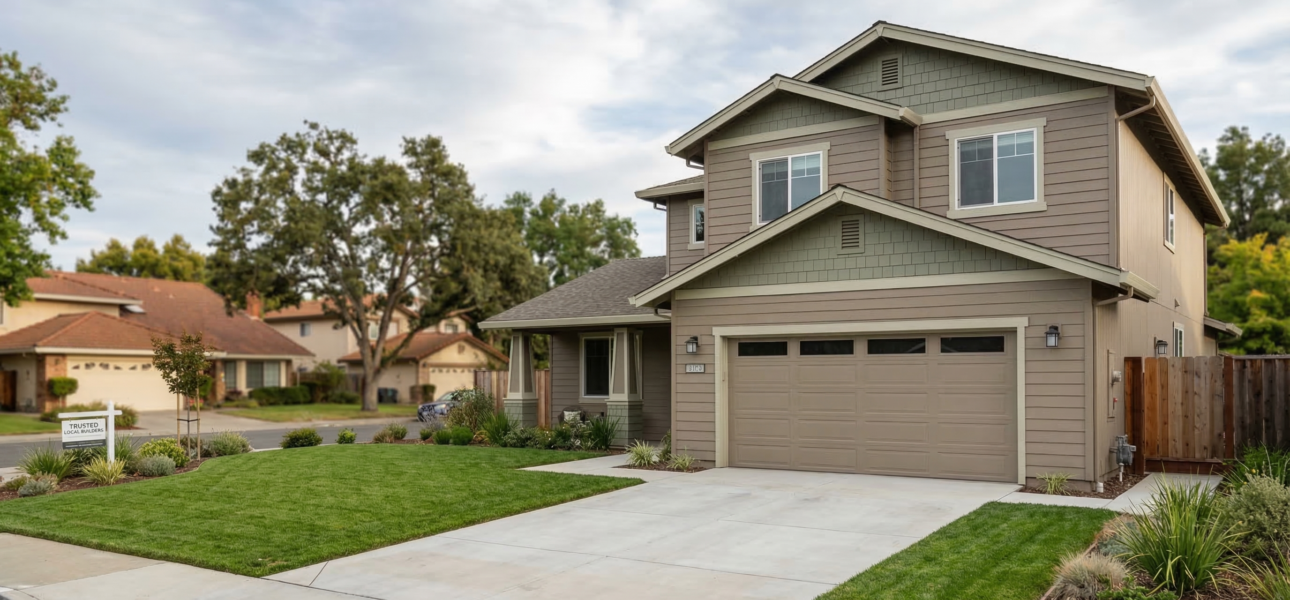
If you’re replacing the siding on your Sacramento home in 2026, two materials will dominate your decision: fiber cement and vinyl. Both are popular. Both are durable. But they perform very differently under Sacramento’s 100°F summer heat, UV intensity, and — for homeowners near the foothills — wildfire ember exposure. Choosing the wrong material doesn’t just cost you money upfront. It can cost you more in maintenance, resale value, and peace of mind over the next 20 to 50 years.
At Vitalii Builders, we install both materials across Sacramento and the surrounding region. This guide gives you the real cost data, performance breakdown, and honest guidance you need to make the right call for your home.
Table of Contents
Fiber Cement vs Vinyl Siding in Sacramento: The Numbers at a Glance
Before diving into the details, here’s a side-by-side comparison based on current 2026 data for the Sacramento market.
| Factor | Fiber Cement (e.g., James Hardie) | Vinyl |
|---|---|---|
| Installed Cost (1,500 sq. ft. home) | $29,000–$35,000+ | $21,000–$24,000+ |
| National ROI at Resale (2026 CVV) | 114% | 97% |
| Lifespan | 50–100 years | 20–40 years |
| Fire Resistance | Class 1(A) — non-combustible | Moderate — can warp and melt |
| Heat Performance (100°F+) | Stable | Prone to warping and fading |
| Maintenance | Repaint every 10–15 years | Wash periodically; panel replacement if cracked |
| Sacramento Permit Range | ~$500–$1,000+ depending on jurisdiction | |
Sources: 2026 Cost vs. Value Report (Zonda/Remodeling Magazine); Vision Siding Sacramento cost data; CAL FIRE Home Hardening guidance.
What Does Siding Replacement Actually Cost in Sacramento in 2026?
Cost is the first question most homeowners ask, and rightfully so. Here’s a realistic breakdown based on Sacramento-specific data from the 2026 Cost vs. Value Report and current local contractor pricing.
Fiber Cement Siding
For a typical Sacramento home with approximately 1,500 sq. ft. of exterior wall area, a full fiber cement replacement — including tear-off, James Hardie or equivalent panels, trim, and professional installation — runs roughly $29,000–$35,000+ Material costs typically range from $5–$14 per square foot, with labor adding another $6–$12 per square foot given the weight and specialized tools required.
The higher cost reflects the material itself, the heavier installation process, and the precision required to properly seal, flash, and caulk fiber cement for long-term performance. Cut corners here, and you void the manufacturer warranty.
Vinyl Siding
Vinyl comes in considerably cheaper. For the same 1,500 sq. ft. home, expect a full replacement to run $21,000–$24,000+ Installed cost per square foot typically lands in the $4–$11 range, with lower labor demands driving a significant portion of the savings.
Insulated vinyl — which includes a foam backing that measurably improves energy performance — runs closer to the top of that range. If comfort and energy bills matter to you, insulated vinyl is the vinyl upgrade worth paying for.
Don’t Forget Permits
Sacramento and surrounding jurisdictions require permits for full siding replacement. Permit fees typically range from $500 to $1,000+ depending on whether your project falls under City of Sacramento, Sacramento County, or a surrounding city’s jurisdiction (Folsom, Elk Grove, Rancho Cordova, etc.). A reputable contractor — like our team at Vitalii Builders — will pull the permit and schedule required inspections for you.
The Sacramento Climate Factor: Why Material Choice Matters More Here
Generic siding comparisons written for the national market underestimate how much Sacramento’s specific climate tilts the decision. Three local factors stand out.
| Sacramento Climate Factor | Impact on Vinyl | Impact on Fiber Cement |
|---|---|---|
| 100°F+ summer heat (50+ days/year) | Can warp, buckle, and fade; expansion gaps critical | Remains dimensionally stable; holds paint well |
| Intense UV exposure | Colors fade faster; may need panel replacement | Fade-resistant; repaint every 10–15 years |
| Foothill wildfire ember risk (WUI zones) | Low melting point; can expose wall sheathing | Non-combustible; Class 1(A) fire rating |
The wildfire angle is especially important for homeowners in El Dorado Hills, Folsom, Orangevale, Citrus Heights, and other communities near the foothill WUI (Wildland-Urban Interface) zones. California’s Building Code Chapter 7A requires exterior materials in designated WUI fire areas to meet specific fire-resistive standards. Fiber cement is non-combustible and meets these requirements. Vinyl, while it doesn’t ignite like wood, has a low melting point — when exposed to radiant heat from a nearby fire, it can warp, melt, and fall away from the wall, exposing the weather barrier and sheathing underneath. According to CAL FIRE’s Home Hardening guidance, that exposed gap is an entry point for embers to reach the wall cavity.
If your home is in or near a designated Fire Hazard Severity Zone, fiber cement isn’t just a better choice — it may be the only code-compliant choice for your next siding replacement.
ROI and Resale Value: What Sacramento Buyers Actually Notice
With Sacramento’s median home sale price sitting around $495,000 as of early 2026 (Redfin, February 2026), siding in poor condition is a negotiation liability. Buyers touring a home form their first impression from the curb — and siding that’s warped, faded, or visually dated signals deferred maintenance throughout the home, even when that’s not the case.
According to the 2026 Cost vs. Value Report from Zonda and Remodeling Magazine:
- Fiber cement siding replacement delivers 114% ROI nationally — meaning homeowners recoup more than they spend at resale.
- Vinyl siding replacement returns 97% nationally — still one of the best-performing remodeling projects in any category.
Why the gap? Fiber cement signals quality to buyers in a way vinyl doesn’t. A home clad in James Hardie reads as a premium product. That perception translates into stronger offers, faster sales, and less buyer leverage on price reductions.
For Sacramento homeowners who plan to sell within the next 5–10 years, fiber cement’s higher upfront cost is often neutralized — or surpassed — at the closing table.
Performance Over Time: Lifespan, Maintenance, and Total Cost
Fiber Cement: Long Lifespan, Some Maintenance Required
Properly installed fiber cement siding can last 50 to 100 years. James Hardie products come with a 30-year limited warranty. The trade-off is maintenance: fiber cement requires repainting every 10–15 years to maintain its appearance and protective coating. Caulking around windows and joints needs periodic inspection and resealing as well.
That said, when you calculate the total cost of ownership — materials, installation, and anticipated maintenance over 30 years — fiber cement often comes out ahead of vinyl, which may need full panel replacements due to heat warping, cracking, or fading in Sacramento’s climate.
Vinyl: Low Maintenance, But Shorter Clock
Vinyl’s biggest advantage is simplicity. An occasional wash with a hose is usually all it needs. There’s no repainting schedule, no caulking inspection routine. For a homeowner who wants to set it and forget it — or who doesn’t plan to stay in the home for decades — vinyl delivers excellent curb appeal and protection at a lower price.
The concern in Sacramento specifically: vinyl’s lifespan shrinks in extreme heat. While vinyl can last 20–40 years in moderate climates, prolonged exposure to 100°F+ temperatures accelerates fading and can cause panels to buckle or warp — especially on south- and west-facing walls. We’ve seen this firsthand on homes throughout the Sacramento metro.
When Fiber Cement Is the Right Call
After working on siding projects across Sacramento, Elk Grove, Rancho Cordova, Folsom, and the surrounding foothills, our team at Vitalii Builders recommends fiber cement when:
- You’re in or near a WUI fire zone. Fiber cement is non-combustible and code-compliant for high fire-risk areas. Vinyl is not.
- You plan to sell in the next 3–10 years. The 114% national ROI and stronger buyer perception mean fiber cement often pays for itself at closing.
- Your home faces west or south. These walls absorb the most UV and heat. Fiber cement holds up significantly better than vinyl on these exposures.
- You want a premium aesthetic. Fiber cement mimics painted wood beautifully — particularly important for historical neighborhoods and HOA-governed communities that have appearance standards.
- Long-term ownership is the plan. The 50–100 year lifespan means you may never replace it again.
When Vinyl Is the Right Call
Vinyl isn’t a compromise — it’s a smart choice in the right circumstances. We recommend it when:
- Budget is a primary constraint. At $21,000–$24,000 for a full replacement versus $29,000–$35,000 for fiber cement, the $8,000–$11,000 gap is real. For homeowners focused on near-term cash flow, vinyl delivers strong results at a lower entry cost.
- You want true zero-maintenance siding. No repainting, no recaulking. Just periodic cleaning.
- The home is not in a fire risk zone. If you’re in central Sacramento, the grid areas, or flat suburban communities far from the WUI boundary, fire resistance is less of a factor.
- You’re planning to sell within 1–2 years. Fresh vinyl dramatically improves curb appeal and still returns close to 97% of its cost — enough to justify the investment before a sale.
- You choose insulated vinyl. If energy performance matters, insulated vinyl with foam backing meaningfully improves your home’s thermal envelope and comfort during Sacramento’s 100°F summers.
What Sacramento Buyers Are Looking For in 2026
Sacramento’s housing market remains competitive, with homes selling for a median of $495,000 and averaging 38 days on market (Redfin, February 2026). Here’s what exterior upgrades buyers respond to most:
- Condition over style. Buyers penalize deferred maintenance heavily. Fresh siding in any material signals a well-maintained home.
- Neutral, versatile colors. Greige, warm whites, and slate tones photograph well and appeal broadly — important for quick sales.
- Fire-resistant materials in foothill areas. Sacramento buyers near the WUI are increasingly savvy about fire risk. Fiber cement is a selling point, not just a checkbox.
- Energy performance. With Sacramento’s hot summers and rising utility costs, insulated siding options are gaining buyer attention, especially among first-time buyers and tech-sector relocators.
- Low maintenance signals. Buyers ask about maintenance schedules. Fiber cement’s long lifespan and vinyl’s wash-only maintenance both appeal — in different buyer segments.
Our Recommendations for Sacramento Homeowners
After completing siding projects across Sacramento, Folsom, Elk Grove, Citrus Heights, and the surrounding foothills, here’s what we tell every homeowner who asks us to help them choose:
- Get the full picture on your location first. Are you in a WUI fire zone? Check the CAL FIRE Fire Hazard Severity Zone map before making any material decision. For foothill communities, this is not optional.
- Think in total cost, not just install cost. A fiber cement project that costs $10,000 more upfront but lasts 3x longer — and returns 114% at resale — is almost always the better financial decision for long-term owners.
- Don’t skip the substrate inspection. Before any new siding goes on, we inspect the sheathing, moisture barrier, and flashing. Covering up water damage with new siding just delays a much more expensive repair.
- Match the product to the wall orientation. South- and west-facing walls take the hardest beating from Sacramento’s sun. If you’re budget-conscious, consider fiber cement on those exposures and vinyl elsewhere.
- Verify HOA requirements before ordering materials. Many Sacramento-area HOAs — particularly in Elk Grove, Natomas, and newer subdivisions — have specific approved material lists and color palettes. We handle this legwork for our clients.
- Choose a certified installer. For fiber cement specifically, improper installation voids the manufacturer warranty. James Hardie’s HZ5 program, for example, is designed specifically for hot, dry climates like Sacramento’s.
Bottom Line: Which Is Right for Your Sacramento Home?
There’s no universally correct answer — but there is usually a right answer for your specific home, budget, and goals.
Choose fiber cement if you’re near a fire zone, plan to stay in the home long-term, want the highest resale value, or have south- and west-facing walls that take the full force of Sacramento’s summer sun. The higher upfront cost is offset by a longer lifespan, stronger ROI at resale, and real protection advantages that matter in Northern California.
Choose vinyl if you’re working within a tighter budget, want zero long-term maintenance, or are preparing a home for sale in the near term. It’s a proven performer that still returns nearly dollar-for-dollar at resale — and insulated vinyl adds genuine energy benefits that Sacramento homeowners will feel every August.
Either way, the material is only part of the equation. Installation quality, proper flashing, substrate condition, and permit compliance determine how long your siding actually performs. That’s where an experienced Sacramento siding contractor makes the difference.
Ready to figure out which option is right for your home? Contact Vitalii Builders for a free assessment — we’ll walk you through the options, check your fire zone status, and give you a straight answer on what we’d recommend for your specific property.